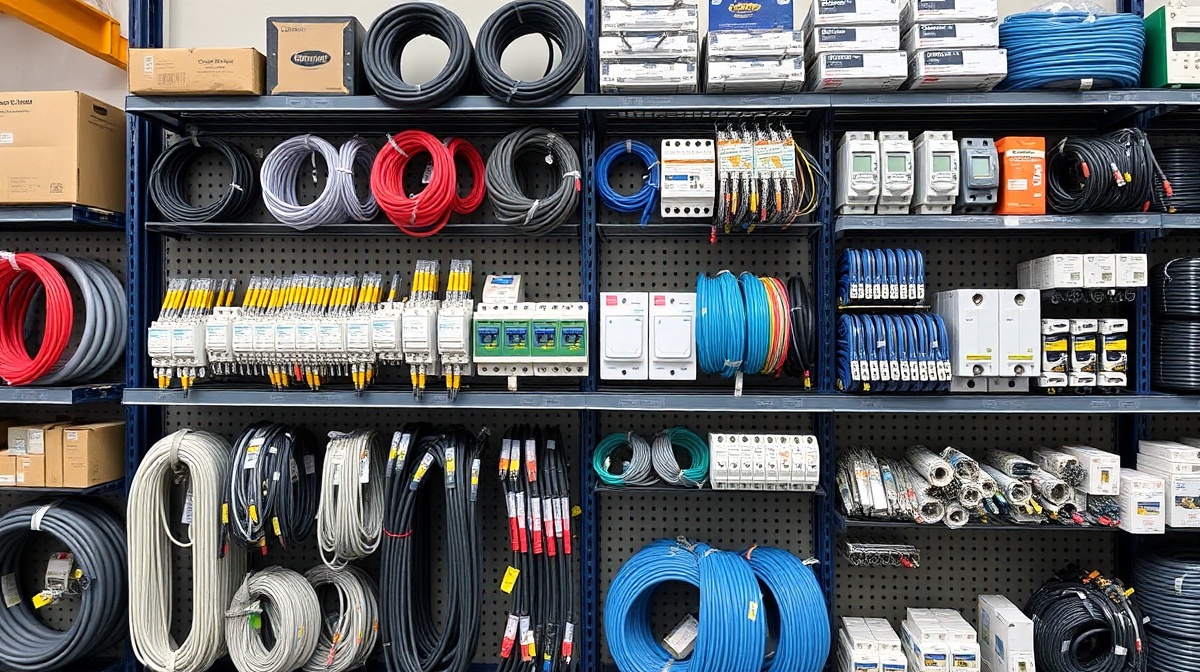
Why Cable Sizing Matters
Undersized cables create multiple problems:
- Energy losses: Excessive voltage drop reduces system output
- Safety hazards: Overheated cables risk fire
- Component damage: Voltage fluctuation damages inverters and equipment
- Warranty issues: Improper sizing can void manufacturer warranties
- Regulatory non-compliance: Violates electrical codes and standards
Proper cable and accessory selection ensures safe, efficient, compliant installations.
DC Cable Sizing Fundamentals
Key Factors in Cable Selection
- Current capacity (ampacity): Must exceed system maximum current
- Voltage drop: Should not exceed 3% DC side, 2% AC side
- Temperature rating: PV cables must handle 90°C+ in hot climates
- UV resistance: All exposed cables must be UV-rated
- Location: Indoor vs outdoor requirements differ
Voltage Drop Calculation
Voltage drop (V) = 2 × Length × Current × Resistance/1000
For a 10kW system with 50m DC cable run:
- Maximum current: ~58A (for 176V nominal DC)
- Maximum voltage drop allowed: 5.3V (3% of 176V)
- Cable resistance limit: 0.046 Ω/km required
- Minimum cable: 4mm² (0.0049 Ω/km for copper)
Common Cable Sizing Mistakes
Mistake 1: Using Standard Electrical Cable
Problem: Regular copper wire lacks UV protection and temperature rating for solar applications.
Solution: Use dedicated PV cable (typically 600V rated, 90°C temperature, UV-resistant jacket).
Mistake 2: Undersizing for Cost Savings
Problem: Saving R500 on cable results in 5% voltage drop, losing R1,000+ annually in energy generation and creating fire hazard.
Solution: Always size for 3% maximum voltage drop, never compromise on safety margins.
Mistake 3: Ignoring Temperature Effects
Problem: Cables in hot (45°C+) South African sun can reach 70-80°C. Standard cable resistance increases 30-40%, increasing voltage drop significantly.
Solution: Use cables rated for 90°C, and when calculating voltage drop, factor in temperature derating (typically 1.25× deration factor for hot climates).
Mistake 4: Improper Cable Protection
Problem: Exposed cables subject to damage from UV, rodents, and weather.
Solution: Use conduit or protective sleeving for all exposed DC cabling. Use UV-rated cable jackets throughout.
Connector and Accessory Selection
DC Connectors: MC4 vs Alternatives
- MC4: Industry standard, widely available, excellent reliability
- MC3/MC2: Older standards, less common, compatibility issues
- Amphenol/Tyco alternatives: Different connector types require converters
Recommendation: Stick with MC4 for consistency and compatibility. Avoid mixing connector types in same system.
DC Combiner Boxes
- String combiner: Combines parallel strings with individual breakers/fuses
- Overcurrent protection: Each string protected independently
- Grounding provision: Must accommodate system grounding
- Voltage rating: Must match system voltage (typically 1000V DC)
Surge Protection Devices (SPD)
South Africa experiences significant lightning risk. SPDs protect against transient overvoltages from:
- Direct lightning strikes
- Induced surges from nearby strikes
- Grid switching events
- Equipment switching (inverters, contactors)
Typical SPD placement: DC side (before inverter) and AC side (after inverter) for comprehensive protection.
Disconnect Switches
- DC disconnect: Between panel array and inverter—essential for safety and maintenance
- AC disconnect: Between inverter and main panel—required by electrical code
- Battery disconnect: For hybrid systems—isolates battery for maintenance
Cable Sizing Quick Reference Table
| System Current | Recommended DC Cable (4mm run) | Overcurrent Protection |
|---|---|---|
| Up to 20A | 2.5mm² PV cable | 25A breaker/fuse |
| 20-35A | 4mm² PV cable | 40A breaker/fuse |
| 35-50A | 6mm² PV cable | 63A breaker/fuse |
| 50-80A | 10mm² PV cable | 100A breaker/fuse |
* Assumes 50m cable run, 3% voltage drop limit. For longer runs, use next larger cable size.
South African Electrical Code Compliance
All solar installations must comply with:
- SANS 10198: Solar energy systems, grid-connected PV installations
- SANS 10142-1: Installation code for low voltage installations
- Local municipality bylaws: Building approval requirements
Proper cable and accessory sizing ensures compliance and installation certification.
Key Takeaways
- Always calculate voltage drop—aim for maximum 3% DC, 2% AC
- Use dedicated PV cable with proper UV and temperature rating
- Account for temperature effects in hot climates
- Protect all cables with conduit or UV-rated jackets
- Size overcurrent protection based on cable ampacity and system current
- Include SPDs for lightning protection
- Proper sizing ensures safety, efficiency, and code compliance
Professional Tip
Always err on the side of larger cables. The cost difference is minimal compared to the performance and safety benefits. A 6mm² cable instead of 4mm² costs ~R200 more but prevents energy loss, improves reliability, and protects your installation reputation.
